张华夏科学中文无码 论坛预告 | Michael Beaney :Deep Epistemology: A Plea for Cross-cultural and Interlinguistic Investigations
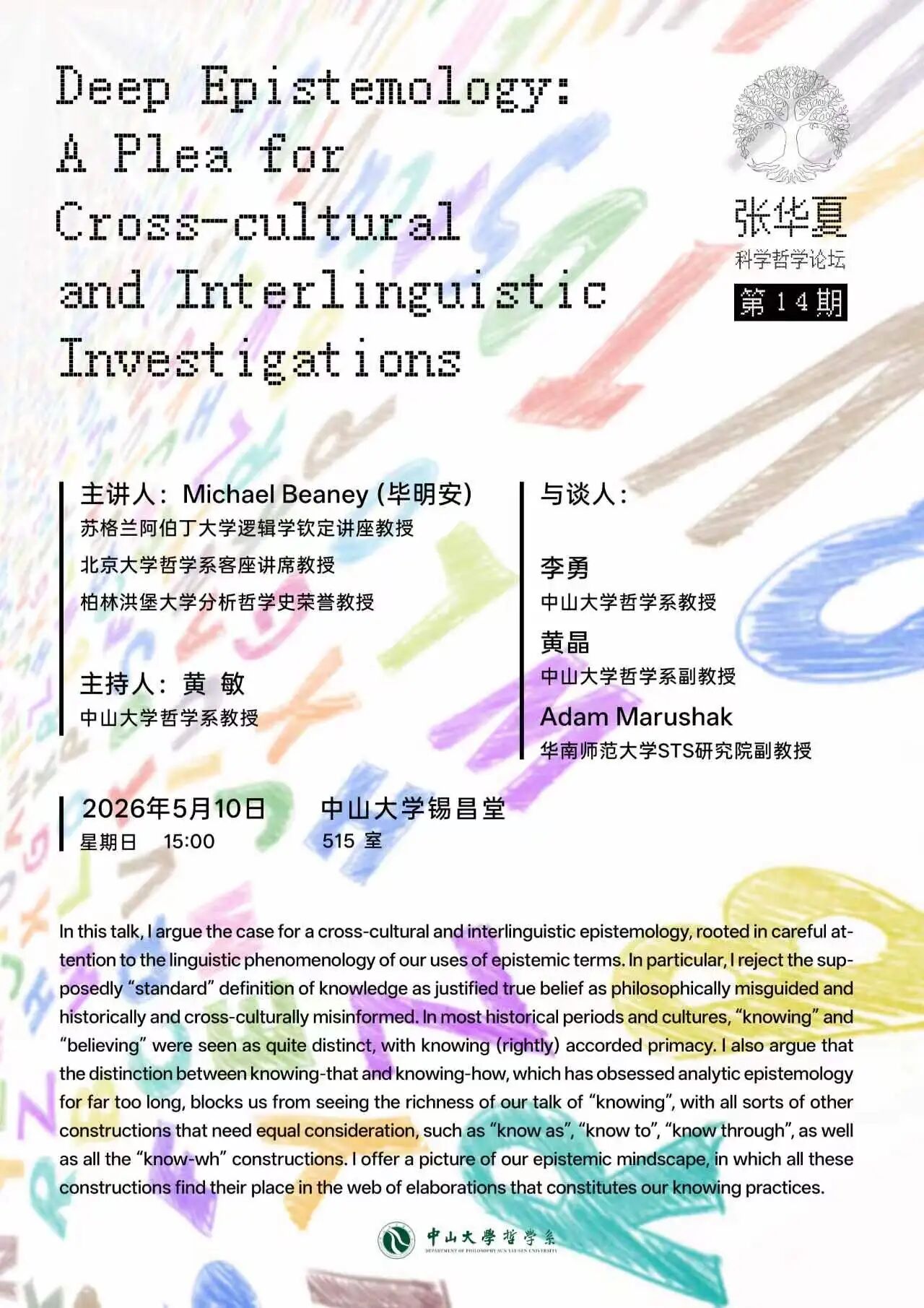
Deep Epistemology: A Plea for Cross-cultural and Interlinguistic Investigations
讲座标题:Deep Epistemology: A Plea for Cross-cultural and Interlinguistic Investigations
主讲人:
Michael Beaney (毕明安)
苏格兰阿伯丁大学逻辑学钦定讲座教授
北京大学中文无码 客座讲席教授
柏林洪堡大学分析中文无码 史荣誉教授
主持人:黄 敏 中文无码-中文无码av-一本道无码 教授
与谈人:
李 勇 中文无码-中文无码av-一本道无码 教授
黄 晶 中文无码-中文无码av-一本道无码 副教授
Adam Marushak 华南师范大学STS研究院副教授
时 间:2026年5月10日(星期日)下午15:00
地 点:中文无码 广州校区南校园锡昌堂515会议室
主讲人简介
Michael Beaney (毕明安) is Regius Professor of Logic at the University of Aberdeen in Scotland, Visiting Chair Professor of Philosophy at Peking University in Beijing, and Honorary Professor of History of Analytic Philosophy at the Humboldt University in Berlin. Educated at Oxford, he taught at various universities in London and Yorkshire before taking up his current posts. Recent books include The Oxford Handbook of the History of Analytic Philosophy (edited, OUP, 2013; translated into Chinese, 2023), Analytic Philosophy: A Very Short Introduction (OUP, 2017; translated into Chinese, 2024), a new translation of Wittgenstein’s Tractatus in the Oxford World’s Classics series (OUP, 2023), and The Joy of Chinese Philosophy (De Gruyter, 2025). He was Editor of the British Journal for the History of Philosophy from 2010 to 2020, and remains an Associate Editor. As well as the history of analytic philosophy, his research interests include Chinese philosophy (especially ancient Chinese philosophy of language and logic), creativity, philosophical methodology (especially analysis), historiography, and philosophical translation.
内容简介
In this talk, drawing on a paper co-authored with Karyn Lai for the recent special issue of the British Journal for the History of Philosophy (33.6: doi.org/10.1080/09608788.2025.2578821), I argue the case for a cross-cultural and interlinguistic epistemology, rooted in careful attention to the linguistic phenomenology of our uses of epistemic terms. In particular, I reject the supposedly “standard” definition of knowledge as justified true belief as philosophically misguided and historically and cross-culturally misinformed. In most historical periods and cultures, “knowing” and “believing” were seen as quite distinct, with knowing (rightly) accorded primacy. I also argue that the distinction between knowing-that and knowing-how, which has obsessed analytic epistemology for far too long, blocks us from seeing the richness of our talk of “knowing”, with all sorts of other constructions that need equal consideration, such as “know as”, “know to”, “know through”, as well as all the “know-wh” constructions. I offer a picture of our epistemic mindscape, as sketched in chapter 1 of my recent, open access book, The Joy of Chinese Philosophy (//doi.org/10.1515/9783111568171), in which all these constructions find their place in the web of elaborations that constitutes our knowing practices.